
I still remember a conversation with an HR leader at a fast-growing software company in Austin. She had just finished interviewing a brilliant machine learning engineer who had recently graduated from a U.S. university.
“He’s exactly what we need,” she said. “But now comes the real challenge—the H-1B lottery.”
Her comment captures a reality many HR professionals face today. Hiring international talent is no longer just about recruitment; it is about navigating a complex system of immigration regulations, lotteries, documentation requirements, and evolving compliance expectations.
As companies continue to compete globally for highly skilled professionals, the H-1B visa program remains one of the most important pathways for U.S. employers to bring specialized talent into their workforce. Yet the program is also undergoing significant changes, making it essential for HR teams to stay ahead of regulatory developments.
For 2026, employers must understand not only the fundamentals of the H-1B program but also new trends in lottery selection, compliance expectations, and potential policy updates that could reshape hiring strategies.
The Core Purpose of the H-1B Visa
The H-1B visa was designed to allow U.S. employers to hire foreign professionals in “specialty occupations” that require highly specialized knowledge and at least a bachelor’s degree or equivalent.
Historically, these roles have been concentrated in fields such as:
- Information technology
- Engineering
- Finance and accounting
- Healthcare and medical research
- Architecture and data science
However, the definition of “specialty occupation” has continued to evolve.
In recent years, the U.S. Department of Homeland Security (DHS) and U.S. Citizenship and Immigration Services (USCIS) have focused more heavily on whether the position truly requires specialized academic training, rather than simply preferring it.
For employers, this means documentation has become more important than ever. Job descriptions must clearly demonstrate that the role requires specific expertise tied directly to a relevant degree.
Immigration attorneys frequently note that vague job descriptions are one of the most common reasons for H-1B petitions receiving Requests for Evidence (RFEs).
Understanding the Beneficiary-Centric Lottery System
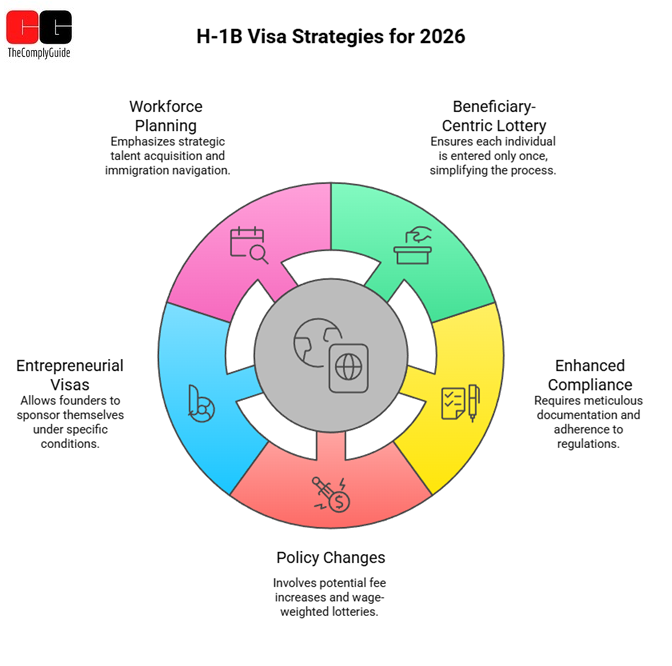
One of the most important changes in recent years has been the introduction of the beneficiary-centric lottery system.
Previously, the H-1B selection process was registration-based, allowing multiple employers to submit registrations for the same candidate. This sometimes resulted in duplicate entries, increasing the chances of selection for certain applicants.
The updated system shifts the focus to the individual beneficiary rather than the employer registration.
In practice, this means:
- Each individual beneficiary is entered into the lottery only once
- Multiple registrations from different employers do not increase selection chances
- USCIS selects beneficiaries first, and then employers may proceed with petition filings
For HR teams, this change simplifies certain aspects of the process but also requires greater coordination with candidates and immigration counsel.
Tips for navigating the new lottery process:
- Confirm unique beneficiary entries to avoid duplicate submissions
- Coordinate early with immigration attorneys before the registration window opens
- Track USCIS selection trends to understand approval rates across industries
- Plan alternative visa strategies if a candidate is not selected
According to USCIS data, the number of H-1B registrations has grown significantly over the past few years, often exceeding 750,000 submissions annually for only 85,000 available visas.
This makes strategic workforce planning increasingly important.
Employer Responsibilities and Compliance Requirements
The H-1B program places significant compliance responsibilities on employers.
Once a petition is approved, companies must maintain strict documentation and adhere to regulatory standards throughout the employee’s period of employment.
Key employer obligations include:
1. Labor Condition Application (LCA) compliance
Employers must file a Labor Condition Application with the Department of Labor confirming that the H-1B worker will be paid the required wage level and that employment conditions will not negatively impact U.S. workers.
2. Public Access File (PAF)
Employers must maintain a Public Access File containing documentation such as:
- Wage determinations
- Job descriptions
- LCA postings
- Evidence of compliance with prevailing wage requirements
3. SEVIS coordination and immigration tracking
For employees transitioning from F-1 student visas under OPT or STEM OPT, HR teams must coordinate with university systems and maintain accurate status records.
4. Site inspection readiness
The Department of Homeland Security has increased worksite inspections in recent years. These audits may verify:
- Work location
- Job duties
- Wage payments
- Employer-employee relationship
Organizations should ensure internal HR and payroll teams are aligned on documentation and compliance procedures.
New Developments: The $100,000 Visa Fee Proposal and Lottery Changes
One topic generating discussion across the HR and immigration communities is the proposal for a $100,000 visa fee aimed at prioritizing high-value roles and discouraging misuse of the program.
While such proposals are still under policy review, they signal a broader shift toward tightening the H-1B system.
Another proposed change involves a wage-level weighted lottery.
Under this approach, H-1B selections could prioritize applicants offered higher wage levels, rather than relying purely on a random lottery.
The goal is to:
- Encourage hiring of highly skilled professionals
- Align visa allocation with labor market demand
- Reduce the use of H-1B visas for lower-paid positions
For HR leaders, this potential change could significantly affect hiring strategies.
Companies may need to:
- Reassess salary structures for sponsored roles
- Align job descriptions with higher wage levels
- Plan recruitment timelines earlier in the year
H-1B Visas for Entrepreneurs
Another emerging topic in the immigration landscape is the growing interest in H-1B visas for entrepreneurs and startup founders.
While the visa category was traditionally designed for employer-employee relationships, entrepreneurs may still qualify if certain governance conditions are met.
To meet eligibility requirements, companies typically must demonstrate:
- A board of directors or governance structure capable of supervising the founder
- The ability for the company to hire, fire, or control the employee’s work
- Evidence that the role qualifies as a specialty occupation
This framework allows startups to sponsor founders while maintaining the employer-employee relationship required by immigration law.
However, documentation must be particularly strong in these cases.
The Growing Role of Workforce Planning
For many HR leaders, the H-1B program is no longer just an immigration issue—it is a strategic workforce planning challenge.
As technology companies, healthcare organizations, and research institutions compete for global talent, the ability to navigate immigration processes efficiently can become a competitive advantage.
According to the National Foundation for American Policy, immigrants have founded or co-founded more than half of America’s billion-dollar startup companies.
This highlights the importance of maintaining pathways for highly skilled professionals to contribute to the U.S. economy.
Practical Strategies for Employers in 2026
To navigate the evolving H-1B landscape, employers should consider several proactive steps.
Start early with workforce planning
Begin identifying H-1B candidates well before the registration period.
Work closely with immigration counsel
Legal experts can help evaluate specialty occupation criteria and documentation requirements.
Strengthen internal compliance systems
Ensure HR, payroll, and legal teams maintain consistent documentation and processes.
Explore alternative visa options
Candidates who are not selected in the H-1B lottery may qualify for visas such as O-1, L-1, or TN.
Stay informed on policy changes
Immigration regulations can change quickly, making continuous monitoring essential.
Looking Ahead
The H-1B visa program has always been a balancing act between economic demand, regulatory oversight, and political debate.
For employers, however, the objective remains simple: securing the specialized talent needed to innovate and compete.
As immigration policy evolves in 2026 and beyond, HR professionals who combine strong compliance practices with thoughtful workforce planning will be best positioned to navigate the complexities of the system.
After all, behind every visa petition is not just a legal process—but a person whose skills may help shape the future of the organization that hires them.